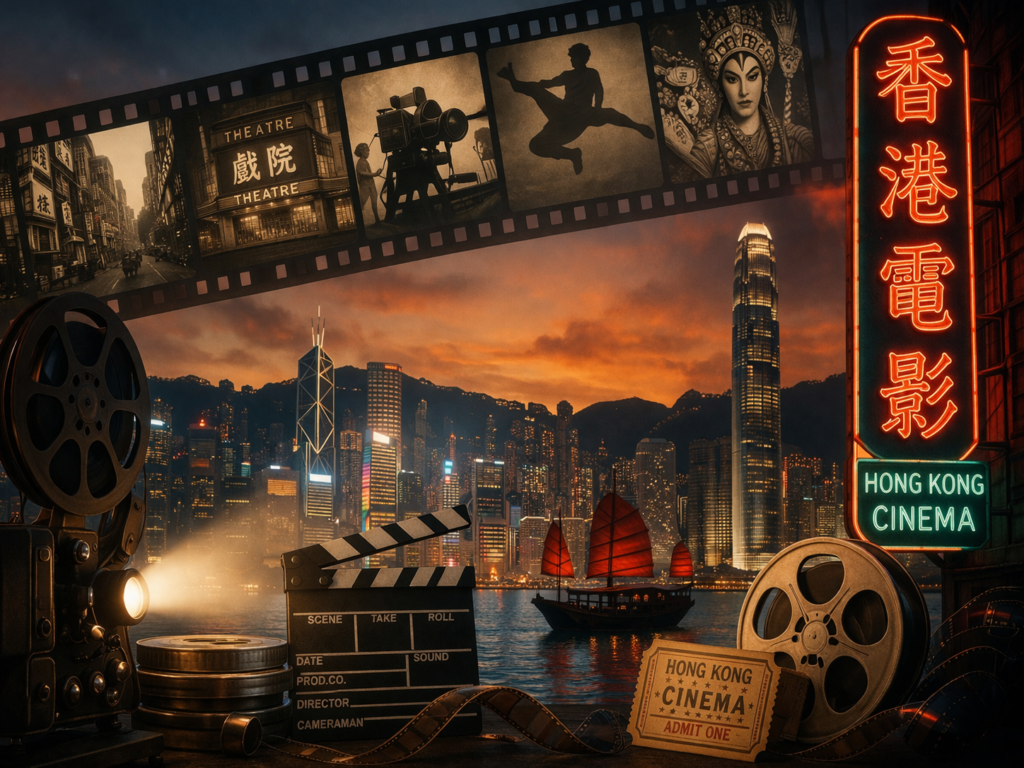
Twenty-three years ago today, a note was left behind in which a man wrote that his heart was too exhausted to love this world anymore. He then jumped from the Mandarin Oriental, Hong Kong. The man was Leslie Cheung, one of the most beloved figures in Hong Kong entertainment. His passing felt like a sudden rupture in a world already in decline—the closing chapter of the luminous era of Hong Kong cinema.
19th Century: A Frontier Transformed
In the 19th century, Hong Kong was a remote fishing village, far removed from Beijing and regarded as a marginal frontier. Its fate changed dramatically due to a pivotal historical event: the Opium War. This was one of three major wars that not only reshaped Chinese history but also played a decisive role in transforming Hong Kong into a global city of cinema.
1. The Opium War (1840–1842): The Beginning of Change
The First Opium War broke out in the mid-19th century when the Qing Dynasty attempted to ban Britain’s opium trade, prompting a military invasion by Britain. The war ended in a decisive British victory. In 1842, the Treaty of Nanking was signed as an unequal agreement between the Qing Dynasty and Britain. Under Article 3 of the treaty, Hong Kong was ceded to British rule.
With its deep natural harbor, Hong Kong quickly developed into a major port. Under British administration, the region underwent rapid transformation. Western culture and technology were swiftly introduced, and a relatively free social environment allowed various industries to flourish. Among these emerging industries was cinema.
In 1895, the Lumière brothers created the world’s first motion picture, Workers Leaving the Lumière Factory (1895). British Hong Kong quickly embraced this new medium. Cinemas began to appear across the region, and by the 1910s, film production companies had been established.
In 1913, Hong Kong produced its first film, Zhuangzi Tests His Wife (1913), directed by Lai Man-wai. This black-and-white silent film marked the beginning of local film production. From this point onward, Hong Kong gradually moved away from reliance on imported films and began to cultivate its own film industry. The Opium War thus became the historical starting point of Hong Kong cinema.
However, just as the industry began to take shape, another devastating conflict would once again reshape Hong Kong’s trajectory.
2. The Second Sino-Japanese War (1937–1945): Growth Amid Turmoil
The Second Sino-Japanese War began with Japan’s invasion of China and continued for eight years. During this period, atrocities such as the Nanjing Massacre forced countless Chinese civilians to flee their homes. Many sought refuge in British Hong Kong. In September 1938, Britain declared Hong Kong a neutral zone, offering a degree of protection from Japanese forces. As a result, both human resources and capital flowed into the territory.
Among those who relocated were numerous filmmakers and industry professionals. Their arrival significantly expanded Hong Kong’s film production infrastructure. Despite the devastation of war, this influx of talent and resources contributed to the growth of the local film industry.
Yet another war would soon follow, further accelerating Hong Kong’s cinematic development.
3. The Chinese Civil War (1946–1949): A New Center for Film
Following the end of the Second Sino-Japanese War, China descended into civil war between the Communist Party, led by Mao Zedong, and the Nationalist Party, led by Chiang Kai-shek. On October 1, 1949, Mao Zedong proclaimed the founding of the People’s Republic of China. As the Communist Party consolidated power, many people fled to Hong Kong once again.
Between 1945 and 1950, Hong Kong’s population increased by approximately 1.7 million. Among the migrants were numerous filmmakers who sought a place where creative expression remained relatively unrestricted. Under British rule, Hong Kong offered one of the most censorship-free environments in Asia, making it an ideal location for film production. As a result, Hong Kong emerged as a new hub for the Chinese-language film industry.
The Rise of a Film Powerhouse: The 1950s and Beyond
By the 1950s, Hong Kong had established itself as a central hub of filmmaking. A key force behind this rise was the Shaw Brothers Studio, which drew inspiration from Hollywood, particularly Warner Bros. Founded by four brothers of the Shaw family, the studio adopted a vertically integrated system that combined production, distribution, and exhibition under one organization. This model allowed for high profitability but required substantial financial investment.
The Shaw Brothers played a crucial role in establishing the wuxia (martial arts) genre as a defining feature of Hong Kong cinema. They built large-scale studios in 1961 and founded training institutions in 1964 to cultivate new talent.
The One-Armed Swordsman (1967), a wuxia film centered on a protagonist who loses one arm, became a defining work of the era. Produced by Shaw Brothers Studio, it not only led the wuxia film boom but also stood as one of the studio’s most representative productions. The film was a major commercial success across Asia and propelled its lead actor, Jimmy Wang Yu, to stardom.
Serving as a catalyst for the surge in wuxia filmmaking during the 1960s, it contributed to a period in which more than 800 wuxia films were produced and distributed internationally by the end of the decade. At its height, Shaw Brothers operated 143 theaters worldwide.
Much like the iconic lion’s roar that opens many American films, Hong Kong cinema became associated with its own signature—four resounding drumbeats that signaled the beginning of a Shaw Brothers production.
Golden Harvest and the Expansion of Genres
Raymond Chow left Shaw Brothers Studio due to dissatisfaction with its studio-only production system and founded Golden Harvest in 1970. From 1985 onward, Golden Harvest became closely associated with the popular hopping-vampire horror cycle, beginning with the jiangshi (“hopping vampire”) films.
In the 1990s, it also helped define the era of Hong Kong wuxia cinema through works such as the Once Upon a Time in China series (1991) (Wong Fei-hung films), while also producing major comedy hits driven by the distinctive style of Stephen Chow.
At the same time, another key figure would emerge who further transformed the trajectory of Hong Kong cinema’s expansion and global reach.
Bruce Lee: A Global Icon
No figure more powerfully represents the global rise of Hong Kong cinema than Bruce Lee. A magnetic action star who continues to excite film audiences worldwide, he was the figure who elevated Hong Kong cinema’s international status to an unprecedented level.
Recognizing his potential, Raymond Chow and Golden Harvest cast Bruce Lee in what would become his breakthrough role in The Big Boss (1971), a landmark production in Hong Kong film history. Produced during a period when Hong Kong cinema was still dominated by wuxia conventions, the film stood out for its unusually realistic, hard-hitting depiction of hand-to-hand combat, marking a decisive shift in action aesthetics and becoming a major commercial success.
At the time, Golden Harvest was still a young studio operating under severe budget constraints. During the filming of The Big Boss, there is a well-known anecdote: in the middle of shooting a tense revenge sequence, Bruce Lee unexpectedly engaged in product promotion to help support production financing. A Thai snack brand associated with one of the film’s key shooting locations provided sponsorship, which was incorporated into filming in the form of visible snack packaging (including brown paper bags), reflecting the improvisational conditions of early Golden Harvest productions. Despite such limitations, the film became a runaway hit.
Following this success, Bruce Lee starred in a series of landmark films, including Fist of Fury (1972) and Way of the Dragon (1972), each reinforcing his status as the era’s defining action star. His popularity extended far beyond Asia, dramatically raising global awareness of Hong Kong cinema. As a result, he was invited to appear on international television programs, including a Canadian broadcast talk show, where he articulated his martial philosophy in one of his most famous statements:
“Empty your mind, be formless, shapeless—like water.
If you put water into a cup, it becomes the cup.
If you put water into a bottle, it becomes the bottle.
If you put it in a teapot, it becomes the teapot.
Be water, my friend.”
This philosophy reflected his martial art system, Jeet Kune Do, which synthesized elements of kung fu with principles drawn from boxing footwork and fencing movement. It explained why audiences were so deeply drawn to what came to be known as “Bruce Lee’s martial arts”—a system defined by adaptability, efficiency, and directness.
In 1973, Bruce Lee entered Hollywood-linked production through Enter the Dragon (1973), a historic co-production between Golden Harvest and Warner Bros., marking a major milestone in East–West cinematic collaboration.
However, his rapidly rising career was cut tragically short. That same year, while working on Game of Death (1978), Bruce Lee collapsed after experiencing sudden headaches and was taken to hospital. He died in 1973 at the age of 32. His death on July 25, 1973, plunged Hong Kong into mourning. The official cause was cerebral edema (brain swelling), though the precise cause of the condition has remained the subject of speculation.
After his death, the production of Game of Death faced major challenges. The storyline was significantly restructured, including narrative devices such as a character undergoing surgery to explain changes in appearance. Of the total 103-minute runtime, only a small portion (less than ten minutes) featured original footage of Bruce Lee. To complete the film, Golden Harvest held auditions and cast South Korean actor Kim Tai-jung to stand in for Bruce Lee in remaining scenes.
Following his passing, Hong Kong cinema entered a difficult transitional phase, marked by a wave of imitation films attempting to replicate his style, underscoring the magnitude of the vacuum left by his sudden death.
Jackie Chan: Reinventing Action
After the passing of Bruce Lee, Hong Kong cinema found a new star in Jackie Chan. His name, given by a director he worked with, carried the meaning of becoming a “successful dragon,” reflecting the expectation that he would surpass Bruce Lee and become one of Hong Kong cinema’s most important figures. Over time, he became one of the most beloved stars in Hong Kong film.
Unlike Bruce Lee’s intense martial arts realism, Jackie Chan developed a distinct style combining action and comedy, effectively helping to shape and popularize the “comedic action” genre that revitalized Hong Kong cinema during a period of stagnation.
Chan’s early life was marked by hardship and rigorous physical training. He entered a Peking Opera school at a young age, where he underwent extremely strict training in performance, acrobatics, and martial discipline. Although this training was often later described by him as harsh and even “torturous,” it provided the foundation for his extraordinary physical abilities. He endured this system with determination, eventually graduating at the age of 17.
Because he did not receive a conventional academic education, he learned scripts by listening to others read them aloud and memorizing them. During this early period, he also worked extensively as a stunt performer, gradually building his career within the film industry. He underwent a cosmetic eyelid surgery after receiving blunt criticism from a screenwriter, who suggested his appearance was not suitable for leading roles in certain productions—an incident that reflects the harsh evaluative culture of the industry at the time.
His breakthrough came with Drunken Master (1978). The film became a major success and established his signature blend of martial arts and comedy, distinguishing him from earlier generations of wuxia and action stars. Later, with Police Story, which he also directed, Jackie Chan fully defined his cinematic identity. The film achieved global success and became known for its highly dangerous, physically demanding stunt work. Jackie Chan became a central figure in the evolution of Hong Kong cinema, redefining action film language through comedy, physical innovation, and unprecedented stunt realism.
A Global Phenomenon
Golden Harvest played a major role in the globalization of Hong Kong cinema, with films being exported to more than 140 countries. A key factor behind this international success was the unique cultural structure of Hong Kong films, often described as a two-headed dragon—combining both Eastern and Western influences. This hybrid identity allowed Hong Kong cinema to appeal to diverse global audiences while maintaining a distinctive local style.
During the 1980s, while many Asian countries operated under strict media regulations and heavy censorship, Hong Kong maintained a comparatively open and flexible environment. This allowed filmmakers to experiment with a wide range of themes and genres, while other regional film industries remained relatively constrained or stagnant due to regulatory and financial limitations.
At the same time, the rapid expansion of the home video market significantly amplified demand for films across Asia. As video consumption grew, so did the need for content. However, in many Asian countries, strict censorship and limited production capital restricted local output. In contrast, Hong Kong’s high-volume film industry produced hundreds of films that were distributed through video networks, spreading widely across neighboring countries and solidifying Hong Kong cinema’s regional dominance.
The Golden Age of Hong Kong Cinema
The Rise of Hong Kong Noir
The film A Better Tomorrow (1986), starring Chow Yun-fat and Leslie Cheung, is widely regarded as the defining work that launched Hong Kong noir cinema. Unlike traditional wuxia films, it emphasized stylized gun violence, emotional intensity, and themes of brotherhood, sparking a major transformation in Hong Kong filmmaking.
Following its success, Hong Kong noir entered a peak period, with influential works such as Rich and Famous (1987), God of Gamblers (1989), A Moment of Romance (1990), and Bullet in the Head (1990), each expanding the genre’s emotional and stylistic range.
Tsui Hark and the Reinvention of Wuxia
Director Tsui Hark played a pivotal role in expanding the creative boundaries of Hong Kong cinema. While helping define the noir era, he also revitalized the wuxia genre through innovative storytelling and advanced visual effects.
His film A Chinese Ghost Story (1987) introduced fantasy-driven wuxia with groundbreaking special effects, marking the beginning of a new technological era in Hong Kong filmmaking. Later, Once Upon a Time in China (1991), starring Jet Li, reimagined a historical folk hero and resonated deeply with audiences across Asia.
Huang Feihong and Historical Wuxia Epics
The Once Upon a Time in China series, beginning in 1991, was based on the historical figure Wong Fei-hung, a martial artist from the late Qing dynasty known for his exceptional skills and strong moral code emphasizing righteousness. The series significantly elevated Jet Li to the status of a major action star, continuing the legacy of figures such as Bruce Lee and Jackie Chan.
The narrative of Wong Fei-hung resonated strongly with Chinese audiences, particularly through its historical backdrop following the Opium Wars and the unequal treaties imposed on China, including the Treaty of Nanking. In this context, stories in which Huang Feihong defeats Western antagonists provided a powerful sense of emotional catharsis.
Due to its immense popularity, the Wong Fei-hung series entered the Guinness World Records in 2001. The franchise became notable for its extraordinary volume, beginning from early cinematic adaptations in 1949 and expanding over decades to produce more than 100 films associated with the character. By 2001, a total of 103 films had been produced, and from 2011 onward, the total count expanded further to approximately 127 films.
Decline and Structural Crisis
Hong Kong cinema saw a period of rapid expansion in which its industrial foundation was heavily supported by external capital. Approximately one-third of Hong Kong films were produced with funding originating from Taiwan, reflecting the strong inflow of capital from across Asia into the industry.
With significant investments from various Asian countries, Hong Kong cinema benefited from a combination of talented directors, popular actors, and strong financial backing. However, despite this apparent stability, the industry began to experience a gradual outflow of capital, leading to an emerging crisis within the film sector.
From 1971 to 1993, Hong Kong cinema continued to grow steadily, reaching its peak in 1993. After this peak, total export revenue began to decline sharply, marking the beginning of a structural downturn in the industry.
Behind this period of commercial success, Hong Kong cinema was also significantly influenced by capital linked to the Triads, which played a substantial role in shaping its industrial structure. The decline of Hong Kong cinema can be attributed to four primary factors.
1. The Triads and Criminal Influence in the Film Industry
The Triads, narrowly defined as organized crime groups based in Hong Kong and broadly across the Chinese-speaking world, are considered one of the world’s three major criminal organizations, along with the Japanese Yakuza and the Italian Mafia (Cosa Nostra). Their activities include gambling, drug trafficking, and prostitution, through which they expanded their influence.
Within Hong Kong, the Triads developed an image as deeply embedded criminal organizations operating beneath the surface of society. Their influence extended into film companies, financial institutions, and media organizations. By disguising themselves as legitimate professions, their organizational scale became extremely difficult to identify or measure.
Recognizing that the film industry was highly profitable, the Triads established their own film companies and began engaging in production and investment activities. In order to recover their investments, they reportedly used coercive methods such as threats and violence, including forcing actors into appearances.
Notable targets included popular actors such as Andy Lau, Anita Mui, Carina Lau, and Jet Li. Due to the widespread influence and abuses committed by the Triads, major figures who had once driven the boom of Hong Kong cinema—including directors such as John Woo and Wong Kar-wai, as well as stars like Jackie Chan and Chow Yun-fat—began leaving Hong Kong and entering Hollywood. This resulted in a mass outflow of directors and actors, described as a tide-like departure from Hong Kong.
2. The Hong Kong Handover (1997)
On July 1, 1997, Hong Kong was officially handed over from Britain to China. With the lowering of the British flag and the raising of the Chinese national flag, 156 years of British colonial rule came to an end.
The development of Hong Kong’s film industry had originally been supported by several key advantages: stable capital conditions, an open and liberal production environment, and the freedom of expression under British colonial governance. These conditions allowed capital and talent to concentrate in Hong Kong, making it an ideal environment for film production. However, following the handover, these advantages were largely lost. Investor confidence in the Hong Kong film industry declined, and capital investment began to withdraw.
During this period of instability, director Wong Kar-wai captured the emotional uncertainty of youth in transition. The film Happy Together (1997), released in the same year as the handover, stars Leslie Cheung and Tony Leung and portrays the unstable relationship of a same-sex couple who travel from Hong Kong to Argentina. Although the title suggests harmony, it is deeply ironic, and is interpreted as a metaphor for the unstable relationship between Hong Kong and China.
3. The Asian Financial Crisis
The 1997 Asian financial crisis caused widespread suffering due to mass unemployment and debt burdens. This crisis significantly affected overseas Chinese communities, who represented a major consumer base for Hong Kong cinema. Beginning in July 1997, the financial crisis spread across East and Southeast Asia, creating widespread economic instability and contributing to global financial uncertainty. As investment declined across the region, the Hong Kong film market also experienced a sharp contraction.
4. The Invasion of Hollywood Blockbusters
While Hong Kong cinema was experiencing stagnation, Hollywood films rapidly expanded across Asian markets. Major blockbuster releases included: Jurassic Park (1993), Independence Day (1996), Mission Impossible (1996), and Titanic (1997) — which became one of the most significant box office hits and further intensified the crisis in Hong Kong cinema.
As competitiveness declined, Hong Kong cinema entered a phase of regression, increasingly producing derivative works that imitated previously successful films. The very capital that once drove the growth of Hong Kong cinema eventually became a structural constraint, turning into a trap that hindered further development.
Legacy and Aftermath
The rapid rise of Hong Kong cinema—often referred to as “Little Hollywood”—was driven by a unique convergence of capital, creative talent, and regional demand. However, the same structural forces that enabled its expansion ultimately contributed to its fragility. On April 1, 2003, Leslie Cheung passed away, an event widely regarded as symbolically marking the end of an era in Hong Kong cinema history.
https://shorturl.fm/NBa6S
https://shorturl.fm/5Z2pa
https://shorturl.fm/UG7zi
https://addlinks.pro/G1rtm