Classical History
BC 1000 – AD 600
The period of cultural history centered on the Mediterranean sea, comprising the interlocking civilizations of ancient Greece and ancient Rome known as the Greco-Roman world and ending with the Fall of Western Rome.
Birth of World Religions
- Three Major World Religions
- Buddhism
- Judaism
- Christianity
Hinduism
- Origin: Indus
- Founder: None
- Core belief / key concept:
- Trimurti (Trinity): Brahma, Vishnu, Shiva
- Brahmanism
- Historical development / spread: Developed from Brahmanism
- Key dates / events: Ancient period (no fixed founding date)
Buddhism
- Origin: Indus
- Founder: Gautama Buddha
- Core belief / key concept: Path to enlightenment and liberation from suffering
- Historical development / spread:
- Flourished during the peak of the Maurya Dynasty
- Later declined in India
- Flourished in China and Japan
- Key dates / events:
- 7C: Flourished in China and Japan
Judaism
- Origin: Near East (Canaan)
- Founder: Abraham (and his followers)
- Core belief / key concept:
- [First] Monotheistic religion
- Jews = Hebrews (Abraham and his followers)
- Historical development / spread: Old Testament as the foundation of Judaism, Christianity, and Islam
- Key dates / events:
- BC 1900: Migration from Ur to Canaan
- Isaac: moved the Hebrews to avoid conflict in Canaan
- Jacob: migrated to Egypt following Joseph to escape famine in Canaan
- BC 13C: Moses (Yahweh) led the Hebrews out of slavery in Egypt
- BC 950: Old Testament written
- BC 539: Hebrews returned to Canaan
Christianity
- Origin: Near East (Roman Judea)
- Founder: Jesus Christ
- Core belief / key concept:
- Salvation through Jesus Christ
- Historical development / spread:
- Emerged from Judaism
- Persecuted by the Roman Empire
- Later adopted by the Roman state
- Key dates / events:
- 30: Jesus crucified
- 64: Great Fire of Rome, Nero blamed Christians
- 70: Jerusalem captured by Titus
- 70–90: New Testament written
- 1C: Domitian persecuted Christians
- 249–251: Persecution under Decius
- early 4C: Diocletian persecuted Christians
- 392: Declared the state religion of the Roman Empire
Islam
- Origin: Near East (Arabian Peninsula)
- Founder: Muhammad
- Core belief / key concept:
- Monotheism
- Last monotheistic religion
- Historical development / spread: stablished in Arabia
- Key dates / events:
Persia
Capital: Persepolis
Neo-Assyrian Empire (BC 1000 – BC 612)
- BC 796: Conquered Old Babylon
- BC 722: Conquered Israel
- BC 700: Conquered Phoenecia
- BC 671: Annexed Egypt, the unification of Israel
- BC 612: Destroyed by the Neo-Babylonian–Median military alliance.
New Babylon (2nd Babylonian/Chaldean Empire) (small state) (BC 600 – BC 539)
- Founded: By the Chaldeans
- BC 612: The Neo-Babylonian–Median alliance destroyed the Assyrian Empire.
- BC 597: Judah was conquered, and the Jewish population was deported (Babylonian Exile).
- BC 568: Egypt was invaded and occupied.
- BC BC: Conquered by Cyrus the Great of Persia
Medes (small state) (BC 8C – BC 550)
Lydia (small state) (BC 1200 – BC 546)
- Destroyed the Hittite Empire.
Persian Empire (BC 557 – AD 651)
- Achaemenid (BC 557 – BC 330)
- Founded: By Cyrus the Great (Cyrus II); the unification of Assyria
- State Religion: Zoroastrianism — moral dualism (the two opposing forces of good and evil); Ahura Mazda
- Political System: Strongly centralized rule; absolute autocracy
- Policies:
- Policy of tolerance: Allowed the Jews to return to their homeland, Canaan
- Province (satrapy) system
- Governor: Satrap
- Royal Road: A road system constructed under Darius I
- Writing and coinage
- Standardization of weights and measures
- BC 547: The Babylonian–Egyptian alliance.
- BC 539: Cyrus conquered Babylon and implemented a policy of tolerance, allowing the Jews to return to Canaan (their homeland).
- BC 525: Egypt was conquered; the unification of the Orient.
- BC 522 – BC 486: Golden Age, reign of Darius I (defeated by Athens at the Battle of Marathon)
- BC 330: Collapsed due to internal revolts
- Greek (Hellenistic Rule) (BC 330 – BC 247)
- Parthian Dynasty (BC 247 – AD 226)
- Sassanid Dynasty (226 – 651)
Greece
Capital: Athens
Innovation: Religion & Phylosophy (replaced traditional myths with reason and logic)
Dark Age (BC 1000 – BC 750)
- Belief: Divine justice (justice determined by religious myths); no scriptures, only mythological poetry about the gods
- BC 800: development of Greek Alphabet
- Fall of Mycenaean civilization → Greek Economic Recession → Disappearance of civilization traces (period of illiteracy) → literacy re-emerges around BC 800
- BC 776: 1st Olympic Games
Archaic (BC 750 – BC 500)
- Innovation: Political & Intellectual (struggle between innovation and tradition)
- Invention: Democracy (birth of Polis)
- Polis: Greek city-states
Mesopotamian city-states:- Similarity: geographic structure (cities for residence and social life, surrounded by countryside for agriculture)
- Difference: central authority based on citizenship (≠ authority based on kings/monarchs)
- Central Authority:
- Citizenship ☞ legal authority
- shared Governance / Political Power (All free male citizens participate in the politics and elections of the polis, governing themselves) ☞ political authority
- People with statuses other than free male citizens:
- Poor citizens: Citizenship + political rights
- Slaves: No rights
- Women: Citizenship (no political rights)
- Innovation: Equality (≠ Near East: monarchy, legal inequality)
- 3 types of societies/political structures based on citizenship
- Oligarchy, Sparta: Decision-making is dominated by a small group of male citizens in the assembly of male citizens
- Tyranny, Corinth: One person rules as a dictator while recognizing citizenship (≠ monarchy-based tyranny)
- Democracy, Athens: [First] democracy; all free male citizens have the right to participate in politics
- Polis: Greek city-states
- Invention: Rationalism
order ⟹ knowable ⟹ explainable ⟹ logic ⟹ foundation of Science & Phylosophy- VS:
- Myths (Tradition)
- View: Mythological
- Political Decision-Making: Authority-Status
- Forces governing the Universe: Whims of the Gods
- Essence of the Universe: Random/Arbitrary
- Rationalism (Innovation)
- View: Rule-based
- Political Decision-Making: Persuasion
- Forces governing the Universe: Imutable Principles f Nature
- Essence of the Universe: Cosmos, and orderly arrangement
- Myths (Tradition)
- VS:
- BC 750: Polis established
- BC 700: Sparta conquered Messenia
- BC 508 – BC 500: Cleisthenes Revolution
Classical
- The Golden Age of Greece (BC 500 – BC 404)
- BC 499 – BC 479: Persian Wars (Greece vs. Persia)
- [Cause] BC 507: failure of Athenian diplomats sent to Darius I to request a defensive alliance
- BC 499 – BC 494: Ionian Revolt (Upprising of the Ionian city-states against the tyrants installed by Persia)
- BC 490: Battle of Marathon (First Persian War): Darius attacks Athens (today’s marathon race commemorates the Athenian soldier who ran from Marathon to Athens to announce the victory, risking his life)
- BC 480 – BC 479: The Great Persian Invasion (Second Persian War): Xerxes (486–465 BC) invades Greece
- BC 480: Battle of Salamis (Third Persian War): the allied Greek navy annihilates the Persian fleet
- BC 478 – BC 431: The Golden Age of Athens
- Athenian Imperialism
- each city-state paid a contribution called a “tribute” according to its size; large cities provided triremes (Greek warships)
- used as a tool of imperial control
- VS:
- Delian League
- Center: Athens
- Consists of: Greek cities in the coast of Asia Minor, islands of the Aegean Sea
- Period: BC 478 – BC 404
- Peloponnesian League
- Center: Sparta
- Consists of:
Peloponnesian region including Corinth - Period: BC 550 – BC 366
- Delian League
- Athenian Radical Democracy
: all free male citizens have the right to participate not only in the ‘assembly’ but also in the ‘judicial system’- Cleisthenes: Athenian constitutional reform (notably: the ostracism system, BC 508) = foundation of Democratic Politics
- Ephialtes: reform of the judicial system (introduction of the popular court)
- Pericles:
- introduced payment for public office to expand citizens’ political participation
- narrowed the scope of citizenship, thereby raising the status of Athenian women
- Government Organization:
- Assembly: open to all free male citizens
- Council of Five Hundred: selected annually by lottery
- Council of Areopagus: ex-archons serve for life
- Executive Board: 10 annual generals and 9 archons selected annually by lottery; other lower officials also chosen by lottery each year
- Judicial Institutions:
- Tradition vs. Innovation
- Cultural Innovations
- Education: [Tradition] no public schools existed; [Innovation] Sophists provided rhetoric and debating lessons at their schools in exchange for money
- Philosophy:
- Socrates
- Protagoras
- Subjectivism: There is no absolute standard of truth because every issue has two mutually incompatible aspects.
- Institutions and values are nomos (customs, conventions, laws), not physis (products of nature); therefore, human institutions are not natural or permanent but arbitrary and temporary.
- Truth is subjective, so both sides of a question can be argued with equal persuasiveness and rationality.
- Agnosticism: Transcendent or supernatural phenomena cannot be known.
- Subjectivism: There is no absolute standard of truth because every issue has two mutually incompatible aspects.
- Theatre: 2 types of public theatre
- Greek Tragedy
- Greek Comedy
- Art
- Social Traditions
- Religion: Traditional religion are preserved by ‘public partilication (Polis)’ (sacrifices, festivals) and ‘private meditation’ (hero cults, mystery cults)
- Women: female citizens enjoy legal privileges and gain respect through their roles in the household and in religion
- Cultural Innovations
- Athenian Imperialism
- BC 431 – BC 404: Peloponnesian War (war between the Delian and Peloponnesian Leagues) – Athens’ defeat (due to plague) ☞ ended The Golden Age
- BC 499 – BC 479: Persian Wars (Greece vs. Persia)
- Post Peloponnesian War (BC 404 – BC 359)
- BC 404 – BC 403: Athenian Civil War; Rule of the Thirty Tyrants (The Thirty Athenian oligarchs who led an oligarchy under Spartan authority)
- BC 403: Athens’ Restoration of Independence
- Socrates
- BC 399: Execution of Socrates (on charges of encouraging the Thirty Tyrants)
- Plato
- despised democray after Socrates’ death
- proposed “rule by philosopher-tyrants” as the ideal form of government
- Philosophical School: Academy (BC 386 – AD 500)
- Metaphysics
- philosophical view on the ultimate foundation of a world beyond human perception
- justice, beauty, goodness, and equality exist in a higher realm that transcends the human world
- Forms (ideas):
- the term for these abstract, immutable, and ultimate moral properties
- the only “true reality”
- what is perceived by humans in this world is an imperfect copy of the metaphysical realities
- ≠ Sophists’ relativism; ultimate moral properties are not relative but universal, immutable, and absolute
- Dualism
- philosophical view that the human soul/mind and body are separate
- humans possess an immortal soul that is distinct from the body
- Aristotles
- tutored Alexander the Great of Macedonia
- Philosophical School: Lyceum (BC 355)
- shared Plato’s view that Athenian democracy was a flawed system
- Macedonia (BC 359 – BC 323)
- BC 359 – BC 336: Philip II’s reign
- BC 336 – BC 323: Alexander the Great’s reign & conquests (destroyed the Persian Empire and built a vast empire stretching from Greece to India; initiated Hellenistic culture within the empire)
- BC 333: Battle of Issus (Hellenic League vs. Darius III’s Achaemenid Empire)
Hellenistic (BC323 – BC 30)
- Hellenistic Kingdoms
- eintroduction of monarchy
- The Three Diadoch: main successor states, or Hellenistic Kingdoms by Alexander’s successorsi
- Antigonid Kingdom: Asia Minor, Near East, Macedonia, Greece
- Seleucid Kingdom: Babylonia and the region eastward to India
- Ptolemaic Kingdom: Egypt
- others: Attalid Kingdom, Parthian Empire, Bactrian Kingdom, Hellenistic kingdoms ruled by non-Greeks, independent Greek cities
- Rome conquered all Hellenistic kingdoms: Antigonus (BC 168), Seleucus (BC 64), Ptolemaios (BC 30)
- Hellenistic Philosophy
- Materialism
- denies Plato’s metaphysics
- philosophical theory that considers matter as the fundamental reality and views mind/spirit as secondary
- follows Aristotle’s idea that only things verifiable by logic and observation truly exist
- Epicureanism
- Stoicism
- Materialism
- BC 323: Death of Alexander the Great
- BC 306 – BC 304: Rise of Alexander’s Successors
- BC 168: Conquest by the Antigonid Dynasty
- BC 167: Maccabean Revolt
- BC 64: Pompey’s conquest of the Seleucid Kingdom
- BC 30: Death of Cleopatra VII; Augustus, Conquest of the Ptolemaic Kingdom
Rome
Capital: Roma → Trier, Milan, Sirmium, Nicomedia (293)
Tradition:
1) Mos Maiorum: “the way of the ancestors” — the traditional moral values and customs followed by Romans.
2) Patron-Client System: a social relationship of mutual obligations between a high-status “patron” and a lower-status “client” in Roman society.
3) Patria Potestas: “paternal power” — the legal authority of the Roman father (paterfamilias) over his household, including his children, wife, and slaves.
Kingdom (BC 753 – BC 509)
- Senate: a group of distinguished men chosen as the king’s personal council; it was always a Roman tradition that one should never make decisions by oneself but only after consulting advisers/friends.
- influenced by: Etruscan civilization
Republic
- Early (BC 509 – BC 287)
- Struggle of the Orders (BC 507 – BC 287): class conflict between the patricians and plebeians in the early Roman Republic.
- Wars in Italy (BC 500 – BC 220)
- Definition: a series of wars fought within the Italian peninsula.
- Result: Rome became the dominant power in the Italian peninsula.
- Establishment of the Roman Republic (BC 509): Roman aristocrats, hostile to monarchy, were influenced by the suicide of Lucretia, which led to the overthrow of the kings and the establishment of the Roman Republic.
- The Struggle of the Orders (BC 507 – BC 287)
- Definition: a political conflict between the plebeians (commoners) and the patricians (aristocrats) in the early Roman Republic.
- Purpose: to achieve political equality for the plebeians and stabilize the republican system.
- Result: the plebeians gained the right to pass laws through their own assembly.
- The Twelve Tables (BC 451 – BC 449): the first written law code of Rome and the foundation of Roman law.
- Political Institutions of the Roman Republic:
- The Consuls: the two chief magistrates of the Republic.
- Cursus Honorum (“Ladder of Offices”): the sequence of elected public offices; quaestor → aedile → praetor → consul
- The Senate: the main advisory council, dominated by the aristocracy.
- Popular Assemblies:
- The Centuriate Assembly: an assembly organized by wealth and military class.
- The Plebeian Assembly (BC 494): represented the plebeians and elected the tribunes, who held the power of veto over senatorial decisions.
- ※ Plebiscites: resolutions passed by the Plebeian Assembly; after BC 287, they became legally binding on all Romans.
- BC 494: establishment of the Plebeian Assembly (Concilium Plebis)
- BC 451 – BC 449: codification of Law of the Twelve Tables
- Mid (BC 287 – BC 121)
- Definition: a series of wars fought against Carthage and in the Near East (BC 500 – BC 220).
- Result: Rome became the dominant power in the Mediterranean world.
- wars against Carthage = The Punic Wars (Rome vs. Carthage; for dominance in the Mediterranean)
- First Punic War (BC 264 – BC 241)
- Second Punic War (BC 218 – BC 201)
- Thid Punic War (BC 149 – BC 146)
- wars against Carthage = The Punic Wars (Rome vs. Carthage; for dominance in the Mediterranean)
- BC 287: Plebeiscites gained legal binding force
- BC 264 – BC 146: Punic Wars
- BC 264 – BC 241: First Punic War
- BC 218 – BC 201: Second Punic War
- BC 149 – BC 146: Third Punic War
- Late (BC 121 – BC 44)
- Definition: period of political and social turmoil (BC 500 – BC 220)
- Result: birth of the Roman Empire
- The Gracchus Brothers (BC 133 – BC 121): Reforms & Factional Politics
- Tiberius Gracchus (BC 133): elected Tribune
- Gaius Gracchus (BC 123): elected Tribune; introduced reforms to distribute land to the proletariat (the landless poor)
- Rise of Roman factional politics:
- Populares: the “people’s party,” supported by the plebeians
- Optimates: the aristocratic senatorial elite
- Gaius Marius & Client Armies (BC 104 – BC 100)
- Marius expanded military recruitment to include the proletariat.
- Previously, only property-owning citizens could serve (military).
- This created client armies loyal to their general rather than to the Republic.
- Sulla (BC 91 – BC 78)
- Social War (BC 91 – BC 87): a rebellion by Rome’s Italian allies demanding Roman citizenship and voting rights.
※ Results:- Rome achieved a military victory; Italian allies gained political victory (citizenship was granted to insurgent state)
- Sulla’s success led to his election as consul in BC 88
- Civil War (BC 83 – BC 81): Sulla vs. Marius; Sulla defeated Marius and emerged as the dominant leader.
- Social War (BC 91 – BC 87): a rebellion by Rome’s Italian allies demanding Roman citizenship and voting rights.
- Collapse of the Republic (BC 83–44): Pompey vs. Julius Caesar
- Pompey’s Achievements
- BC 66: Defeated Mithridates in Asia Minor
- BC 64: Annexed Syria; Overthrew the Seleucid dynasty
- First Triumvirate (BC 60 – BC 53): alliance between Pompey-Caesar-Crassus
- Caesar’s Civil War (BC 49 – BC 45): Caesar defeated Pompey; Pompey fled to Egypt.
- Julius Caesar (BC 44): attempted to end factional conflict; assassinated in BC 44
- Pompey’s Achievements
- The Gracchus Brothers (BC 133 – BC 121): Reforms & Factional Politics
- BC 91 – BC 87: Social War (War of the Allies)
- BC 83 – BC 44: fall of the Roman Republic
- BC 83 – BC 81: Sulla–Marius Civil War (Sulla win)
- BC 60: First Triumvirate
- BC 49 – BC 45: Pompey–Caesar Civil War (Caesar win)
- BC 44: Caesar assassinated after establishing dictatorship
Republic → Principate (BC 44 – BC 27)
= 17 years of civil war (a period of civil wars that ended the Roman Republic and led to the establishment of the Principate.)
- Augustus and the Establishment of the Principate:
- Octavian → Augustus (“the revered one”)
- In BC 27, Octavian took the title Augustus and established the Principate, often described as a disguised monarchy.
- Title: princeps (“the first citizen of Rome”)
- Augustus maintained the traditional republican institutions (Senate, consuls, courts) while holding real power.
- Pax Romana (BC 27 – AD 180): roughly 200 years of peace and stability secured by Augustus’s political system.
- Second Triumvirate (BC 43): alliance between Mark Antony-Lepidus-Octavian
- War between Second Triumvirate (BC 32): Octavian vs. Antony; faction conflict.
- Battle of Actium (BC 31):
- a naval battle in which the allied fleet of Antony and Cleopatra VII was defeated by Octavian.
- This battle marked:
- the end of the Hellenistic Age
- the beginning of the Roman Imperial era
- End of Antony and Cleopatra (BC 30):
- Antony and Cleopatra VII committed suicide.
- Octavian conquered Ptolemaic Egypt.
- BC 43: Second Triumvirate
Empire (Principate)
- Rax Romana
- Augustus’ reign (BC 27 – AD 14)
- = First Roman emperor; Golden Age of Latin literature
- BC 32: War of the Second Triumvirate
- BC 31: Battle of Actium
- BC 30: Augustus conquered the Ptolemaic Kingdom (Egypt)
- Julius-Claudius Dynasty (14-68)
- = First Dynasty
- Tiberus
- Caligula
- Claudis
- Nero (54 – 68)
- 64: Great Fire of Rome
- 69: Year of the Four Emperors (civil war)
- Flavian Dynasty (69-96)
- Vespasian (69-79)
- 70: Titus captured Jerusalem (Fall of Jerusalem)
- Titutus
- Domitian
- Colosseum construction completed
- Nerva (96-98)
- Vespasian (69-79)
- Golden Age (Five Good Emperors) (96-180)
- = Political Golden Age of Rome; Silver Age of Latin LiteratureNerva (96-98)
- Trajan: Roman Empire at its largest territorial extent
- Hadrian
- Antonius Pius
- Marcus Aurelius
- Augustus’ reign (BC 27 – AD 14)
- Crisis (180-284)
- = Crisis of the Third Century
- Crisis of the Third Century (235–284): a fifty-year period of civil war, political instability, and external invasions.
- Battle of Edessa (260): Sasanian Persian king Shapur I captured the Roman emperor Valerian.
- End of Pax Romana (284)
- 230s – 280s: Era of the Soldier Emperors
- 249 – 251: persecution of Christians by Decius
- 260: Battle of Edessa
- = Crisis of the Third Century
Empire (Dominate)
- Diocletian (284-304)
- = Reformation
- Title: dominus (“lord”)
- Tetrarchy (293):
- a system of “rule by four,” in which the Empire was governed by: 2 senior emperors (Augusti), 2 junior emperors (Caesares)
- The Empire was effectively divided into four administrative regions.
- Rome was no longer the capital.
- Four Imperial Districts:
- Constantius (Trier)
- Maximian (Milan)
- Galerius (Sirmium)
- Diocletian (Nicomedia)
- a system of “rule by four,” in which the Empire was governed by: 2 senior emperors (Augusti), 2 junior emperors (Caesares)
- 293: Diocletian implemented the Tetrarchy
- Constantine I (306-337)
- = Christianization
- Edict of Milan (313): aproclamation issued by the co-emperors Constantine I (a Christian) and Licinius (a pagan) granting religious toleration and freedom of worship throughout the Empire.
- Constantine I’s Conversion (312): Constantine converted to Christianity after his victory at the Battle of the Milvian Bridge.
⇒ Theodosius I (392): Christianity was declared the official religion of the Roman Empire. - Eastern Orthodoxy (the Orthodox Church)
- Christian Orthodoxy, the Eastern Church (≠ the Western Church): distinction between orthodoxy and heresy; major heresies included Monophysitism, Nestorianism, and Donatism
- Nicene Creed (325): at the Council of Nicaea (AD 325), the Church condemned Arianism as heresy and defended orthodox doctrine by proclaiming the same substance (homoousios) of God the Father and Jesus Christ
- 312: Constantine I’s conversion to Christianity
- 313: Edict of Milan
- 325: Nicene Creed (Council of Nicaea)
- Great Migration & Fall of Roman Empire (337-476)
- Division of Rome (395)
- Implemented by Theodosius I
- Eastern Roman Empire → Arcadius
- Western Roman Empire → Honorius
- Division of Rome (395)
| Western Roman Empire (395-476) | = Roman Catholic Church (Medieval Europe; Western Europe) 476: Fall of Rome (fall of Western Roman Empire) ✔ last emperor: Romulus Augustulus ✔ Causes: 1. Barbarian invasions (non-Roman peoples were referred to as barbarians by Romans) 2. Germanic tribes migrated west: ① to escape attacks by the Huns, ② because they were attracted by Rome’s prosperity ✔ Consequences: 1. Germanic peoples ⇒ became the successors of the Western Roman Empire ⇒ Formation of medieval Europe 2. Beginning of the Middle Ages (medieval Europe) |
| Eastern Roman Empire (395-600) | = Byzantine Empire (Eastern Europe): start 518 – 565: reign of Justinian I “the Great”; Peak of Eastern Roman Empire 532: Nika Riots – major civil unrest in Constantinople 534: Corpus Juris Civilis (Justinian Code) – codification of Roman Law ✔ ordered by Emperor Justinian I to be compiled by jurists ✔ codified Roman law, separating public law and private law ✔ considered as the foundational source for the principles of modern legal systems Pope Gregory I (Gregory the Great) ✔ Papacy strengthened; Gregorian Chant standardized ✔ asserted the independence of the Roman Church from Byzantine (Eastern) authority 7C: Dark Ages of Byzantine Empire |
The Germanic Migration (4C/375-568)
- Germanic kingdoms = Barbarian (Non-Roman) kingdoms
- Germanic people = successors of the Western Roman Empire
- Eastern Germanic Tribes
- Region: Central/Eastern Europe
- Example: Ostrogoths, Visigoths, Vandals, Burgundians
- Note: often migrated south or west under pressure from the Huns; major role in the fall of the Western Roman Empire.
- Western Germanic Tribes
- Region: Central/Western Europe (modern Germany, France, Netherlands)
- Example: Franks, Saxons, Alemanni, Lombards
- Note: many settled in Gaul, Italy, and Britain; foundation of medieval kingdoms like the Frankish Empire.
- Northern Germanic Tribes
- Region: Scandinavia (Denmark, Norway, Sweden)
- Example: Danes, Swedes, Norwegians
- Note: often called “Vikings” during 8C – 11C; raided, traded, and later settled across Europe; some became Normans in France.
- Non-Germanic People
- Region: Balkans & Eastern Europe
- Example:
- Slavs: later divided into
- West Slavs (Poles, Czechs, Slovaks)
- East Slavs (Russians, Ukrainians, Belarusians)
- South Slavs(Serbs, Croats, Bulgarians)
- Avars
- Slavs: later divided into
- Note:
- Eastern Germanic Tribes
- 375: beginning of the Great Migration (Migration Period) – the Ostrogoths, along with the entire Germanic peoples, entered Roman territory to escape the Huns’ invasion from Asia, triggering the fall of the Western Roman Empire.
- 392: Christianity declared as official religion of the Roman Empire.
- 395: Roman Empire permanently divided into the Eastern and Western Empires
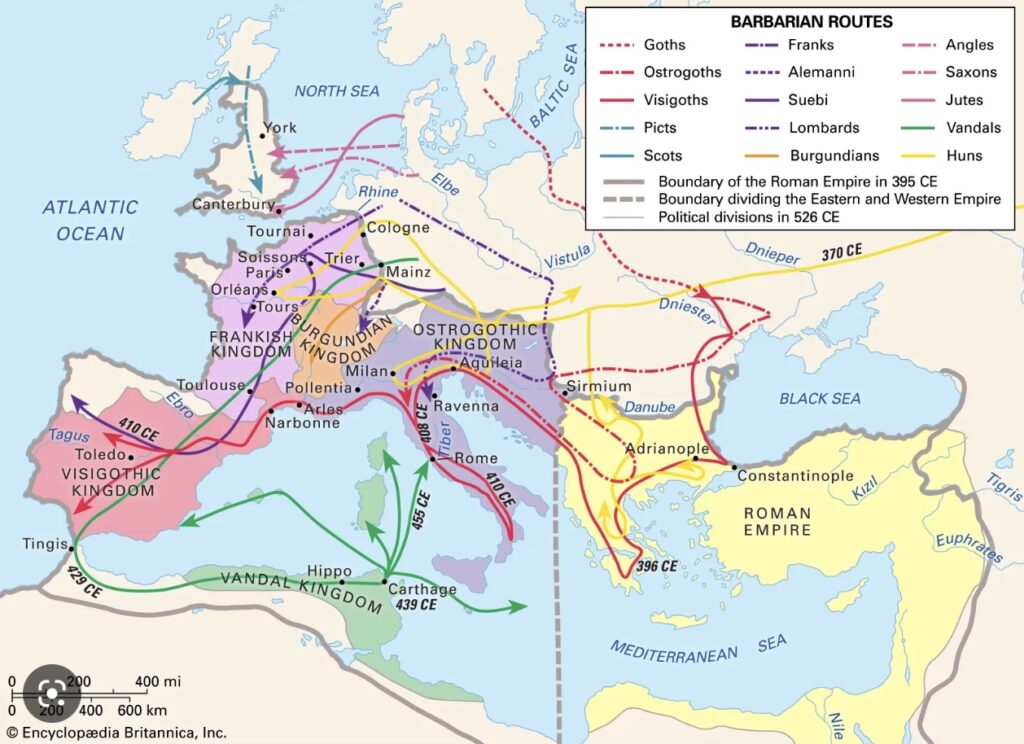
Italy
- Odoacer’s Kingdom of Italy (476-493)
- Kingdom of the Ostrogoths (493-554)
- 493–553:: Theoderic I (ruler of the Ostrogoths) conquered Italy and established Ostrogothic Kingdom of Italy reflecting Roman administration
- 554: Justinian I (Byzantine Emperor) expelled the Ostrogoths and took control of Italy
- Byzantine rule (554-568)
- Kingdom of the Lombards (568-774)
- 568: Lombards invaded Italy
- 572: Lombards established the Kingdom of the Lombards in northern Italy (initially divided into 35 dukedoms, later unified under Authari, r. 584–590)
- 590-616: Agilulf’s reign; Agilulf converted the Lombards to Catholicism (603-607)
- 774: last Lombard king Desiderius deposed by Charlemagne
Spain
- Kingdom of the Visigoths (469-711)
- 418: settled in southwestern Gaul as allies of the Romans
- 469: conquered Spain
- 507: defeated by the Frankish army at the Battle of Vouillé (Poitiers) and retreated to Spain
- Agila (r. 549–554): Lost southeastern Spain to the Byzantines
- Fall: Muslim conquest (711; weakened by civil war after Roderick took the throne)
France
- Francia (Frankish Kingdom) 486/509-843
- = Middle Ages
- Significance:
became the successors of the Western Roman Empire - 486: founded by Clovis; Clovis defeated the Roman governor Syagrius at the Battle of Soissons → established Merovingian dynasty
- 496: Clovis converted to orthodox (Nicene) Catholicism
UK
- Anglo-Saxons (411-1066)
- Until 411: = under Roman administrative division; in 5C – 6C, Germanic invaders (Jutes, Angles, Saxons) expelled the indigenous Romano-Celtic population.
- 7C: Heptarchy (7 kingdoms politics: Kent, Sussex, Wessex, Essex, Northumbria, East Anglia, Mercia)
- Expansion of Wessex:
- Wessex, Mercia, Northumbria: major kingdoms among the seven
- 9C: Danish Invasion (Northumbria/Mercia)
- 878: Battle of Edington – Alfred the Great (r. 871–899) defeated the Vikings (defended Wessex from the Danish Invasion)
- Edward the Elder (r. 899–924): Unification of England (a single Anglo-Saxon monarchy)
- The British Isles: England, Wales, Scotland, Ireland
- Normans (600-1050)
- 911-1087: settled in Normandy, England and southern Italy
- 911: Carolingians granted Normandy to the Viking ruler Rollo in exchange for protection against other invaders
- The Norman Conquests:
- Rollo’s successors (the Dukes of Normandy) established a hybrid Norman state
- 1066: William the Bastard, Duke of Normandy, invaded England, became king, and founded the Norman Kingdom of England
- 1040s: Robert Guiscard invaded southern Italy and Sicily, establishing the Kingdom of Sicily that lasted until 1194, when it was conquered by Henry VI of Germany
- Vikings (739-1069)
- took advantage of the divisions between Carolingian France and Anglo-Saxon England to launch invasions
- 793: attacked Lindisfarne
- 9C: colonized Danemlaw (northeastern region in England)
- 870: settled in Iceland
- late-10C: settled in northern America
Germany
- Ottonian kings (10C-11C German kings; starting with Otto I, r. 936–973)
Balkans
Egypt
- Predynastic Period (c. 5500 – 3100 B.C.): Early settlements and agriculture developed, leading up to the unification of Egypt.
- Early Dynastic Period (c. 3100 – 2686 B.C.): The unification of Egypt under the first pharaohs, with capital established at Memphis.
- Old Kingdom (c. 2686 – 2181 B.C.): Known as the “Age of the Pyramids,” a period of centralized government and massive monument construction (e.g., Giza pyramids).
- First Intermediate Period (c. 2181 – 2055 B.C.): A period of political instability, regional conflict, and civil war.
- Middle Kingdom (c. 2055 – 1650 B.C.): Known as the “Age of Reunification” or “Golden Age,” featuring expansionist military campaigns and artistic growth.
- Second Intermediate Period (c. 1650 – 1550 B.C.): The Hyksos, a foreign power, controlled parts of Northern Egypt.
- New Kingdom (c. 1550 – 1069 B.C.): Egypt’s “Imperial Age,” a powerful era of pharaohs like Thutmose III, Hatshepsut, and Ramesses II, who expanded the empire to its greatest extent.
- Third Intermediate Period (c. 1069 – 653 B.C.): A time of fragmentation with rulers from Libyan and Nubian dynasties.
- Late Period (c. 653 – 332 B.C.): Egypt was intermittently ruled by foreign powers, including the Persians, until conquered by Alexander the Great.
- Ptolemaic Period (332 – 30 B.C.): Macedonian Greek rule (started by Ptolemy I, a general of Alexander), ending with the death of Cleopatra VII.
- Roman Period (30 B.C. – A.D. 642): Egypt became a province of the Roman Empire, marking the formal end of the pharaonic era.